Best French Press Coffee Makers (2026)
The French press is coffee at its most elemental: grounds, water, time, plunge. No paper filters, no electricity, no complicated settings. Just pure, full-bodied coffee with all its natural oils and flavors intact.
It’s also one of the most forgiving brewing methods. Unlike pour-over (which demands precision) or espresso (which demands expensive equipment), the French press produces great coffee with minimal technique and almost any budget.
After aggregating reviews from coffee professionals, enthusiast forums, and thousands of owner experiences, here are the best French presses for every kitchen and budget.
Quick Answer: Our Top Picks
| French Press | Best For | Price | Capacity |
|---|---|---|---|
| Bodum Chambord | Best Overall | ~$40 | 34 oz (8 cups) |
| Fellow Clara | Best Premium | ~$105 | 24 oz (6 cups) |
| Stanley Adventure | Best Travel | ~$35 | 32 oz |
| Bodum Brazil | Best Budget | ~$25 | 34 oz (8 cups) |
| Espro P7 | Best for Clarity | ~$110 | 32 oz |
Why French Press? The Case for Full-Immersion Brewing
What Makes French Press Different
Most coffee makers use paper filters that trap oils and fine particles. The French press uses a metal mesh that lets everything through — resulting in:
- Fuller body — Natural coffee oils remain in the cup
- More flavor — No paper to absorb aromatic compounds
- Thicker mouthfeel — Fine particles add texture
- Simpler cleanup — No filters to buy, no waste
The Trade-Offs
- Sediment — Some fine grounds always make it through the filter
- Requires coarse grind — Fine grind = muddy, over-extracted coffee
- Manual operation — No timers, no automation
- Heat loss — Glass models cool faster than double-wall insulated
When to Choose French Press
French press excels for:
- Bold, heavy coffees (Sumatra, dark roasts)
- People who like “chewy” coffee with body
- Breakfast blends that need to cut through milk
- Campers and travelers (no electricity needed)
- Budget-conscious brewers (cheap equipment, great results)
Skip French press if:
- You prefer bright, tea-like coffee (use pour-over instead)
- You hate sediment in your cup
- You want to brew and forget (automatic drip is better)
- You drink light roasts exclusively (clarity is lost)
🏆 Best Overall: Bodum Chambord
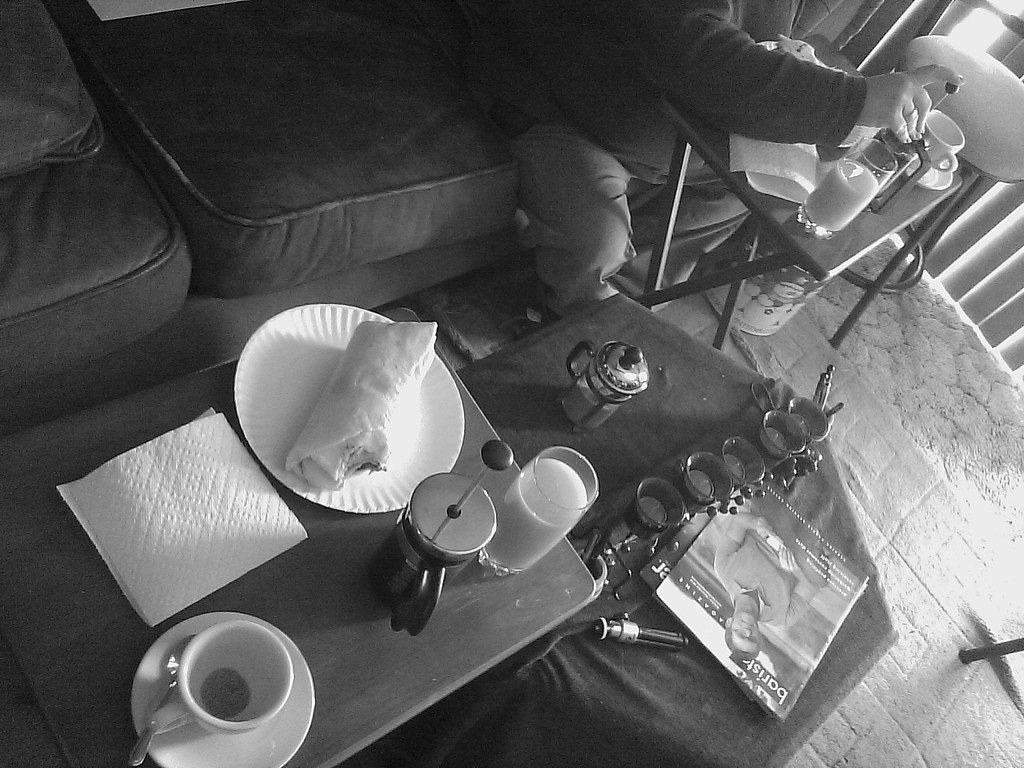
The Bodum Chambord is the French press. Originally designed in the 1950s, it’s the icon that all others are measured against — and for good reason. It’s beautiful, functional, and produces consistently excellent coffee.
Specs at a Glance
| Feature | Specification |
|---|---|
| Material | Borosilicate glass beaker, chrome-plated frame |
| Capacity | 34 oz (8 “cups” — really 3-4 mugs) |
| Filter | 3-piece stainless steel mesh |
| Dimensions | 4.5” x 4.5” x 9” |
| Weight | 1 lb |
| Dishwasher Safe | Beaker only |
Who This Is For
- First-time French press buyers — The classic for a reason
- Style-conscious kitchens — Looks beautiful on the counter
- Daily drinkers — Durable enough for everyday use
- Coffee traditionalists — Nothing beats the original
Who Should Skip It
- Clumsy users — Glass beaker will break if dropped
- Slow drinkers — Single-wall glass loses heat in 15-20 minutes
- Sediment haters — Standard mesh lets some fines through
What Reviewers Love
- Timeless design — Looks at home in any kitchen
- Replacement parts available — Beakers are cheap and easy to find
- Consistent results — Simple mechanism, nothing to fail
- Proper capacity — 34 oz is perfect for 2-3 people
Common Complaints
- Glass breaks — Beaker is fragile; order a spare
- Heat loss — Not insulated, coffee cools relatively quickly
- “8 cups” is misleading — Bodum counts 4 oz cups; expect 3-4 real mugs
- Mesh can bend — Rough handling deforms the filter over time
Bodum Chambord Variations
| Model | Price | Notes |
|---|---|---|
| Chambord (glass) | ~$35 | The classic |
| Chambord (chrome) | ~$40 | More durable frame |
| Chambord (copper) | ~$50 | Aesthetic upgrade |
The Verdict
If you’re buying your first French press or want a reliable daily driver, the Bodum Chambord is the answer. It’s the benchmark for a reason.
⭐ Best Premium: Fellow Clara
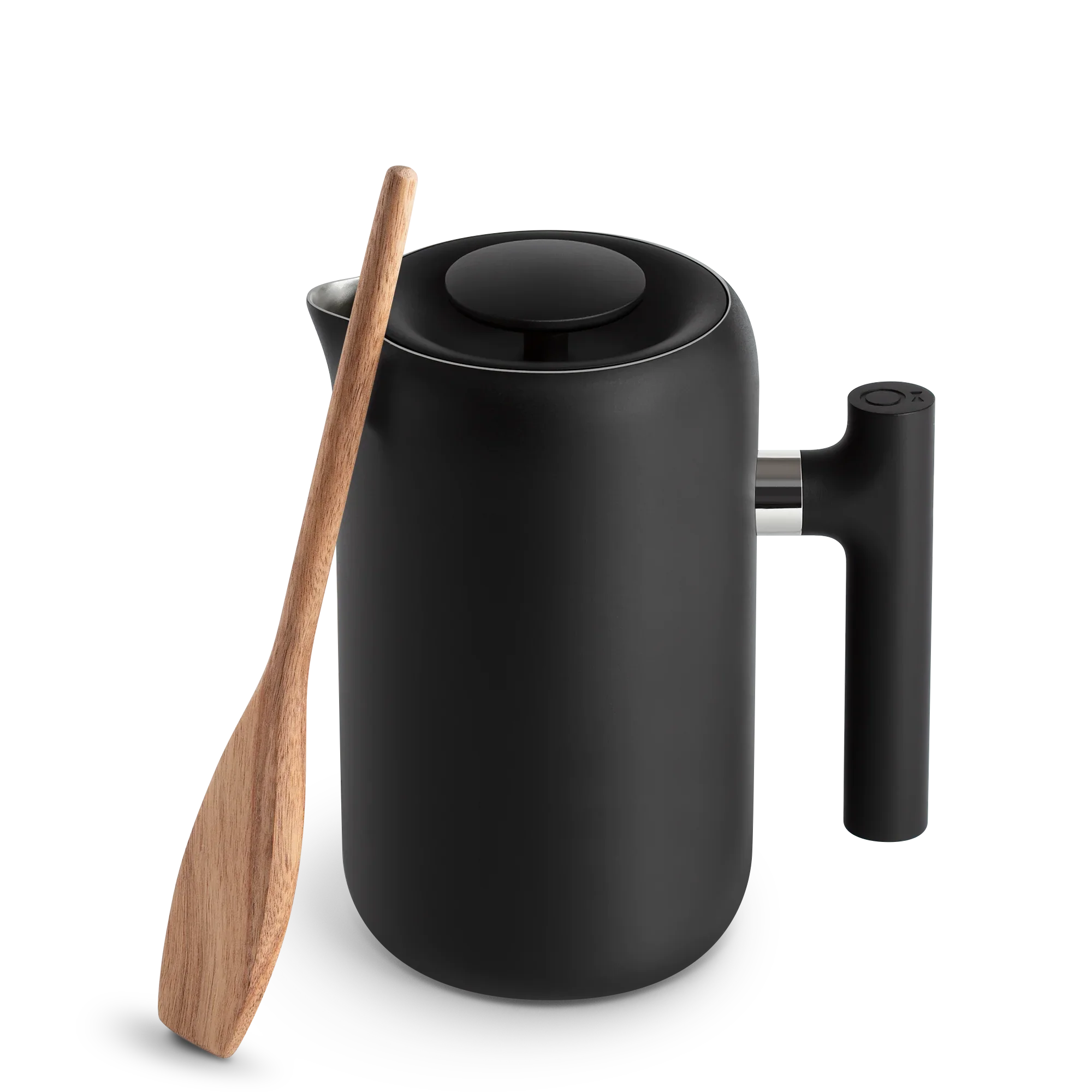
The Fellow Clara is what happens when you redesign the French press for modern coffee enthusiasts. It addresses every common complaint: heat loss, messy pouring, sediment, and awkward cleanup.
Specs at a Glance
| Feature | Specification |
|---|---|
| Material | Double-wall vacuum-insulated stainless steel |
| Capacity | 24 oz (6 “cups” — really 2-3 mugs) |
| Filter | Enhanced mesh with finer filtration |
| Dimensions | 4.5” x 4.5” x 8” |
| Weight | 1.5 lbs |
| Special Features | Heat retention, agitation stick, fine mesh |
Who This Is For
- Coffee enthusiasts — The premium features matter if you geek out on coffee
- Slow drinkers — Keeps coffee hot for 60+ minutes
- Sediment avoiders — Finer mesh than most presses
- Design lovers — Fellow products are objets d’art
Who Should Skip It
- Budget shoppers — At $95, it’s a luxury
- Large households — 24 oz capacity is smaller than the Chambord
- Traditionalists — Doesn’t have the “classic” French press experience
What Reviewers Love
- Heat retention — Double-wall insulation keeps coffee hot for an hour+
- Less sediment — Enhanced mesh catches more fines
- Thoughtful design — Agitation stick, all-direction pouring, easy-clean interior
- Beautiful — Matte black or white finish looks stunning
Common Complaints
- Price — Nearly 3x the cost of the Bodum Chambord
- Small capacity — 24 oz is tight for 3+ people
- No window — Can’t see how much coffee is left
- Learning curve — Different feel than traditional presses
Premium Features Explained
| Feature | Benefit |
|---|---|
| Double-wall insulation | Keeps coffee hot 60+ min |
| Enhanced mesh filter | Less sediment in cup |
| Agitation stick included | Proper brewing technique |
| Non-stick interior | Easier cleanup |
| All-direction pour | No “spout” to aim |
The Verdict
If you drink French press daily and want the best possible experience, the Fellow Clara is worth the investment. It solves every traditional French press problem — for a price.
💰 Best Budget: Bodum Brazil
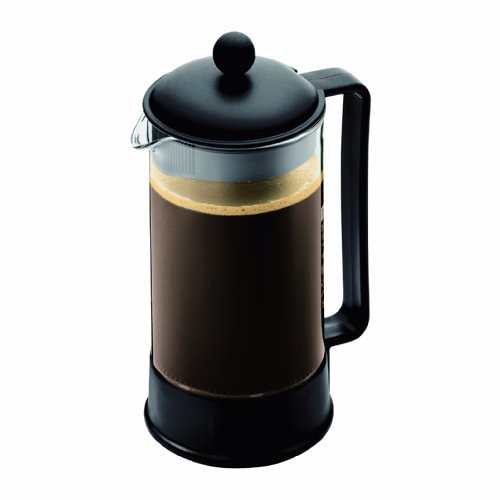
The Bodum Brazil is the Chambord’s younger sibling — same beaker and filter, simpler frame. For ~$20, it delivers 95% of the Chambord experience at half the price.
Specs at a Glance
| Feature | Specification |
|---|---|
| Material | Borosilicate glass beaker, plastic frame |
| Capacity | 34 oz (8 “cups”) |
| Filter | 3-piece stainless steel mesh |
| Dimensions | 4.5” x 4.5” x 9” |
| Weight | 0.8 lbs |
| Dishwasher Safe | Beaker only |
Who This Is For
- Budget-conscious buyers — Great press for $20
- Students and first apartments — Cheap but functional
- Sporadic French press users — No need to invest more
Who Should Skip It
- Daily drinkers — Plastic frame feels less premium
- Style-focused buyers — The Brazil looks utilitarian
- Durability seekers — Plastic frame can crack over time
What Reviewers Love
- Price — Unbeatable value at $20
- Same internals as Chambord — Beaker and filter are identical
- Lightweight — Easier to handle than metal-frame models
- Replacement parts — Same beaker fits Chambord and Brazil
Common Complaints
- Plastic frame — Feels cheap compared to metal
- Less durable — Plastic can crack if dropped
- Heat loss — Same single-wall glass as Chambord
Brazil vs. Chambord
| Feature | Brazil | Chambord |
|---|---|---|
| Price | ~$20 | ~$35 |
| Frame material | Plastic | Chrome metal |
| Beaker | Same glass | Same glass |
| Filter | Same mesh | Same mesh |
| Longevity | Good | Better |
| Appearance | Functional | Beautiful |
The Verdict
The Brazil is the practical choice. Same brewing performance as the Chambord for $15 less. If you don’t care about aesthetics, this is the one.
🏕️ Best Travel: Stanley Adventure

The Stanley Adventure combines a French press with a vacuum-insulated thermos. It’s built for campers, road-trippers, and anyone who needs hot coffee away from a kitchen.
Specs at a Glance
| Feature | Specification |
|---|---|
| Material | 18/8 stainless steel, double-wall vacuum insulation |
| Capacity | 32 oz |
| Heat Retention | Hot 4+ hours, warm 8+ hours |
| Dimensions | 3.5” x 3.5” x 10” |
| Weight | 1.1 lbs |
| Warranty | Lifetime warranty |
Who This Is For
- Campers and hikers — Indestructible and portable
- Road-trippers — Makes coffee anywhere with hot water
- Outdoor workers — Keeps coffee hot all day
- Clumsy users — Virtually unbreakable
Who Should Skip It
- Home-only brewers — Overkill for kitchen use
- Light coffee drinkers — 32 oz is a lot for one person
- Pour-over enthusiasts — This is purely for French press
What Reviewers Love
- Indestructible — Stanley’s legendary durability
- Keeps coffee hot for hours — Vacuum insulation works
- All-in-one — Press, thermos, and travel mug
- Lifetime warranty — Stanley stands behind their products
Common Complaints
- Sediment — Mesh isn’t as fine as glass presses
- Learning curve — Pressing mechanism takes practice
- Hard to clean — Narrow opening, especially outdoors
- Coffee taste — Some report slight metallic taste initially
Stanley Adventure vs. Regular French Press
| Feature | Stanley Adventure | Bodum Chambord |
|---|---|---|
| Material | Stainless steel | Glass |
| Breakable? | No | Yes |
| Heat retention | 4+ hours | 20 minutes |
| Weight | 1.1 lbs | 1 lb |
| Price | ~$30 | ~$35 |
| Best for | Travel/outdoors | Home |
The Verdict
If you need coffee away from home — camping, work sites, travel — the Stanley Adventure is unmatched. It’s a thermos that makes coffee. What’s not to love?
🔬 Best for Clarity: Espro P7
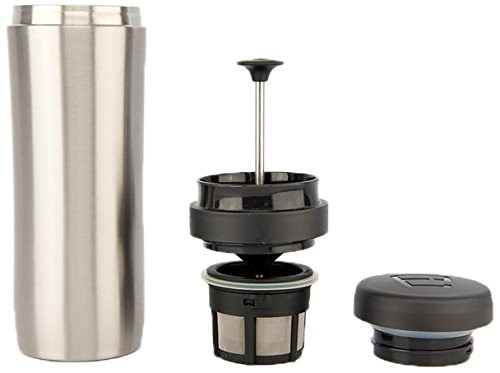
The Espro P7 solves the French press’s biggest problem: sediment. Its patented double-filter system produces cleaner coffee than any other press.
Specs at a Glance
| Feature | Specification |
|---|---|
| Material | Double-wall vacuum-insulated stainless steel |
| Capacity | 32 oz |
| Filter | Patented dual micro-mesh |
| Heat Retention | Hot 1+ hour |
| Dimensions | 4” x 4” x 10” |
| Weight | 1.8 lbs |
Who This Is For
- Sediment haters — Cleanest French press coffee possible
- Light roast drinkers — Clarity lets delicate notes shine
- Coffee enthusiasts — Willing to pay for engineering
- Slow drinkers — Insulated body keeps coffee hot
Who Should Skip It
- Budget shoppers — At $100, it’s a serious investment
- Traditional French press lovers — Different experience, less body
- Beginners — Complex filter system has learning curve
What Reviewers Love
- Almost no sediment — Dual filter catches fines that pass through other presses
- Clean flavor — More clarity, less “mud”
- Insulated — Keeps coffee hot for an hour
- Versatile — Can also brew tea and cold brew
Common Complaints
- Price — Most expensive in its category
- Less body — Cleaner cup means less of that French press “heft”
- Complex filter — More parts to clean
- Stiff plunger — Takes more force than traditional presses
How the Double Filter Works
Traditional French press: Single mesh lets fines through
Espro P7:
- Outer filter — Coarse mesh catches large particles
- Inner filter — Micro-mesh catches fines
- Silicone seal — Creates vacuum, prevents bypass
Result: Coffee almost as clean as pour-over, with French press convenience.
The Verdict
If you love French press convenience but hate sediment, the Espro P7 is worth the premium. It’s a completely different experience — clean, bright, almost pour-over-like clarity.
French Press Brewing Guide: How to Make Great Coffee
The Basic Method
- Heat water — 200°F (just off boil)
- Grind coffee coarse — Like sea salt
- Add coffee — 1:15 ratio (1g coffee per 15g water)
- Pour water — Wet all grounds evenly
- Stir — At 1 minute, break the crust
- Steep — 4 minutes total
- Plunge — Press slowly and steadily
- Serve immediately — Don’t let it sit on grounds
The Golden Ratios
| Strength | Coffee | Water | Example |
|---|---|---|---|
| Light | 1:17 | 30g | 510g water |
| Balanced | 1:15 | 35g | 525g water |
| Strong | 1:12 | 45g | 540g water |
For a standard 34 oz French press:
- Balanced: ~60g coffee (½ cup) + 900g water (34 oz)
Common Mistakes & How to Fix Them
| Problem | Cause | Solution |
|---|---|---|
| Bitter coffee | Water too hot or steeped too long | Use 200°F water, steep 4 min max |
| Weak coffee | Not enough coffee | Use 1:15 ratio minimum |
| Muddy coffee | Grind too fine | Use coarse grind (sea salt texture) |
| Sediment everywhere | Pressing too fast | Plunge slowly, pour gently |
| Cold coffee | Glass press, slow drinking | Preheat press, use insulated model |
| Sour taste | Under-extracted | Steep longer, finer grind |
Advanced Techniques
The “James Hoffmann” Method:
- Add coffee and water, stir to wet all grounds
- Wait 4 minutes, stir crust (grounds floating on top)
- Scoop off foam and floating grounds
- Wait 5 more minutes for grounds to settle
- Don’t plunge — pour through the mesh at top
- Result: Cleaner cup with less sediment
Cold Brew French Press:
- Use 1:8 ratio (coarse grind)
- Add room-temperature or cold water
- Steep 12-16 hours (fridge or counter)
- Plunge and serve over ice
- Dilute 1:1 with water or milk
Grind Size Matters
| Too Fine (Espresso) | Just Right (French Press) | Too Coarse (Cold Brew) |
|---|---|---|
| Muddy, over-extracted | Clean, balanced | Weak, under-extracted |
| Hard to press | Easy plunge | Water runs through |
| Bitter, harsh | Full, rich | Sour, thin |
If you don’t have a grinder: Buy whole beans and grind at the store. Ask for “French press” or “coarse” grind. Use within a week.
Buying Guide: Which French Press Is Right for You?
By Budget
| Budget | Best Press | What You Get |
|---|---|---|
| $15-$25 | Bodum Brazil | Basic but functional |
| $30-$40 | Bodum Chambord, Stanley Adventure | Classic design or travel-ready |
| $90-$100 | Fellow Clara, Espro P7 | Premium features, insulation, clarity |
By Use Case
| Use Case | Recommended Press | Why |
|---|---|---|
| First French press | Bodum Chambord | The classic, easy to use |
| Daily home use | Bodum Chambord or Brazil | Reliable, affordable |
| Camping/travel | Stanley Adventure | Indestructible, insulated |
| Office | Fellow Clara | Quiet, insulated, less mess |
| Coffee enthusiast | Espro P7 | Cleanest cup possible |
| Budget-conscious | Bodum Brazil | 95% of performance at half price |
By Coffee Preference
| Coffee Style | Recommended Press | Why |
|---|---|---|
| Dark roasts, bold cups | Bodum Chambord | Full body, traditional |
| Light roasts, delicate notes | Espro P7 | Clarity without sediment |
| Anything, anywhere | Stanley Adventure | Versatile, portable |
| Clean but rich | Fellow Clara | Balanced approach |
By Household Size
| People | Capacity Needed | Recommended Model |
|---|---|---|
| 1 person | 12-17 oz | Bodum Chambord 12 oz |
| 2 people | 24-34 oz | Bodum Chambord 34 oz, Fellow Clara |
| 3-4 people | 34-51 oz | Bodum Chambord 51 oz, Stanley Adventure |
| 5+ people | Multiple presses | Two 34 oz presses |
Maintenance & Longevity
Cleaning Your French Press
After Each Use:
- Dump grounds (compost if possible)
- Rinse beaker and filter with hot water
- Use a brush to remove stuck grounds
- Air dry or hand dry
Weekly Deep Clean:
- Disassemble all parts
- Soak in warm, soapy water
- Clean mesh thoroughly (grounds hide in the layers)
- Rinse and reassemble
Monthly:
- Descale with vinegar solution (if you have hard water)
- Check for cracks in glass (replace if found)
- Inspect mesh for tears or warping
Replacing Parts
| Part | Cost | When to Replace |
|---|---|---|
| Glass beaker | $10-$15 | When cracked or chipped |
| Mesh filter | $8-$12 | When torn or severely bent |
| Plunger assembly | $15-$20 | When loose or warped |
Extending Glass Press Life
- Never plunge with force — if it’s hard to press, grind is too fine
- Don’t use metal utensils to scoop grounds
- Avoid thermal shock — don’t pour boiling water into a cold press
- Store with plunger up (not compressed)
Frequently Asked Questions
Why is there sediment in my coffee?
French press uses a metal mesh, not a paper filter. Some fines always pass through. Solutions:
- Use coarser grind
- Try Espro P7 (double-filtered)
- Let coffee settle 30 seconds after plunging
- Pour slowly and stop before the last ounce
Can I use regular pre-ground coffee?
You can, but it’s not ideal. Pre-ground is usually medium-fine (for drip), which causes over-extraction and sediment. For best results, grind your own beans coarse.
How long should I steep?
4 minutes is the standard. Longer = more extraction (potentially bitter). Shorter = less extraction (potentially sour). Experiment with 3-5 minutes to find your preference.
Why does my French press coffee taste bitter?
Usually one of three reasons:
- Water too hot — Use 200°F, not boiling
- Steeped too long — Stick to 4 minutes
- Grind too fine — Coarse grind for French press
Can I make tea in a French press?
Absolutely! French press works great for loose-leaf tea. Just clean thoroughly between coffee and tea to avoid flavor crossover.
Is French press coffee bad for my cholesterol?
Unfiltered coffee (French press, Turkish, boiled) contains cafestol, a compound that can raise LDL cholesterol. If you have cholesterol concerns:
- Paper-filtered coffee (drip, pour-over) removes cafestol
- Limit French press to 1-2 cups per day
- Consult your doctor
Why does my plunger feel stiff?
Usually grind is too fine, or there’s a lot of fine particles blocking the mesh. Try:
- Coarser grind
- Rinsing the filter before brewing
- Less coffee (lower ratio)
Can I reheat French press coffee?
You can, but it won’t taste the same. Reheating coffee breaks down compounds and creates a stale, bitter flavor. Better to make a fresh batch or use an insulated press that keeps it hot.
The Bottom Line
For most people, the Bodum Chambord at ~$40 is the right choice. It’s the classic French press that’s been perfecting home brewing for 70 years. Beautiful, functional, and replaceable parts keep it running forever.
If you need coffee on the go, the Stanley Adventure at ~$35 is indestructible and insulated.
And if you want the cleanest possible French press coffee — almost pour-over-like clarity — the Espro P7 at ~$110 is worth the premium.
The French press is the most forgiving way to make great coffee. No timers, no paper filters, no expensive equipment. Just coarse grounds, hot water, and four minutes of patience.
Last updated: July 2026. Prices and availability may vary. We earn from qualifying purchases.
Questions? Drop a comment below or check out our other coffee equipment guides!